
This Java project implements an algorithm to find the maximum matching in a bipartite graph and determines whether the matching is perfect (all nodes are matched). The algorithm is optimized for both time and space efficiency.
Project Overview
The algorithm takes multiple sets of bipartite graphs as input and outputs the size of the maximum matching for each set, along with a flag indicating whether the matching is perfect.
Problem Description
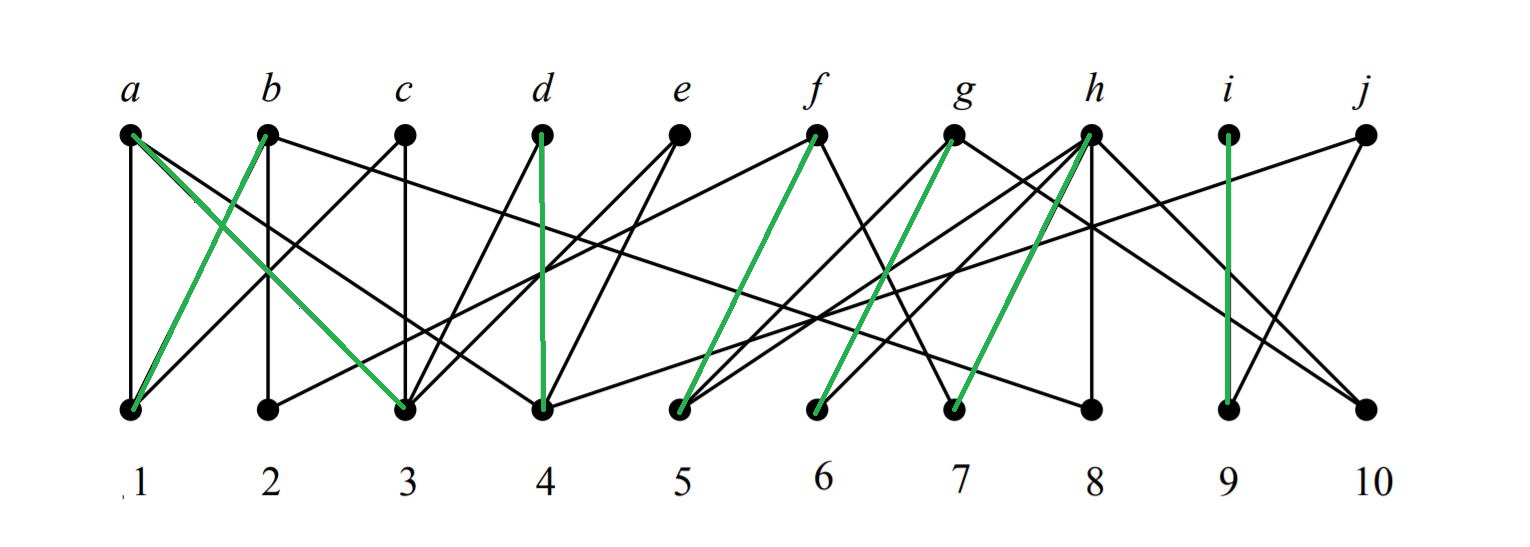
Each input instance describes a bipartite graph with two sets of nodes (A and B) and edges connecting nodes across these sets.
Input Format
First line: An integer N, the number of graph instances.For each instance:
- First line: Three integers m, n, q representing the number of nodes in sets A and B, and the number of edges, respectively.
- Next q lines: Each line contains two integers i and j which denotes an edge from node i in set A to node j in set B.
Sample Input
3
2 2 4
1 1
1 2
2 1
2 2
2 3 4
2 3
2 1
1 2
2 2
5 5 10
1 1
1 3
2 1
2 2
2 3
2 4
3 4
4 4
5 4
5 5
Output Format
For each instance, output the size of the maximum matching followed by Y if the matching is perfect and N otherwise.
Sample Output
2 Y
2 N
4 N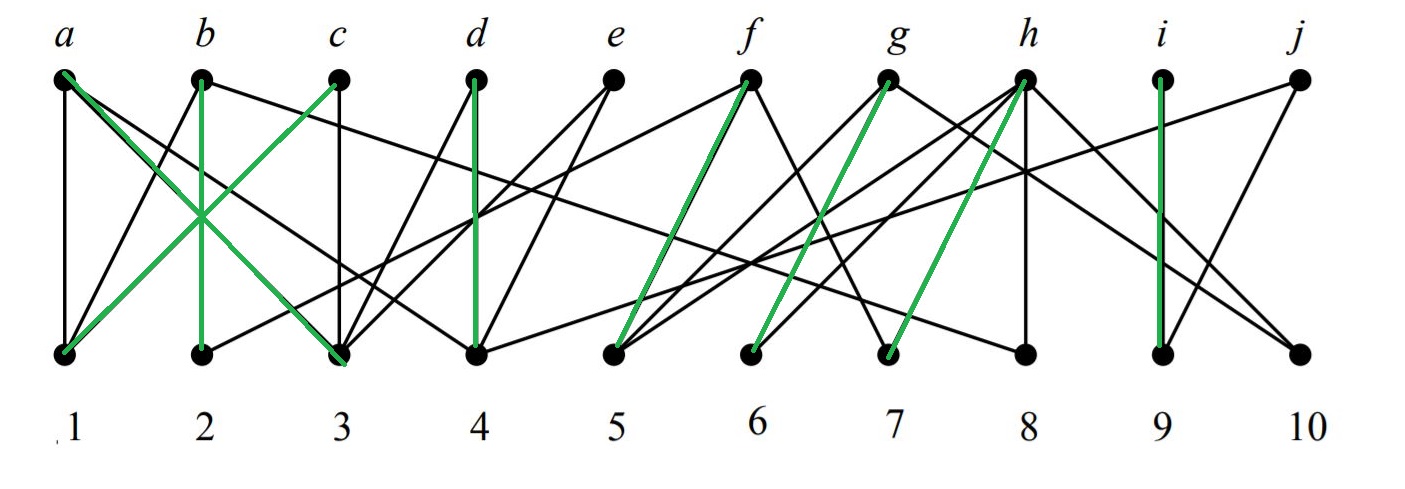
Time Complexity
The implemented algorithm runs in O(n * E) time, where n is the number of nodes and E is the number of edges.
Getting Started
Prerequisites
- Java JDK 8 or later.
Running the Application
Running Locally
- Download the File:
Matching.java - Compile the Code:
javac matching.java - Run the Program:
java matching
Using Makefile
- Download the Makefile:
Makefile - Make the Makefile:
make
License
Distributed under the MIT License. SeeLICENSE.txt for more information.